Start here
So What Do You Actually Do?
Introducing the Six-Layer Method, and why the order of the layers matters as much as the layers themselves.
Read the article →I help senior leaders design the operating model AI needs in order to deliver: who does the work, how decisions are made, what the organisation knows, and how it is all governed.

I have watched three technology waves hit the same wall: ERP, digital and now AI. I call the space between what an organisation intends and what it is designed to deliver the Activation Gap.
AI widens it, because AI changes the assumption every operating model framework was built on: that people do the work and technology supports them. Closing the gap is not a technology project. It is a design job.
Find out where your operating model is not ready for AI, and why, across the six layers that AI changes.
Workshop or full assessment →Redesign those layers in the right order, so each decision informs the next and technology is chosen last.
Operating model design →Keep senior transformation leadership in the room while the design is implemented, so it holds under pressure.
Fractional Transformation Director →Each layer produces requirements the next must satisfy. Technology chosen before the process is designed shapes the process instead of serving it.
Which tasks AI performs, which people keep, and who is accountable for every AI output.
Processes redesigned for AI as they are really run, with explicit handoffs and exception paths.
Decisions classified by type, with defined human review and a real ability to override.
Your own expertise and institutional memory, made available to the AI in your processes.
Platforms chosen last, against the requirements the first four layers produce.
One framework every new AI deployment is assessed against before it goes live.

I started in the ERP era, when the challenge was persuading organisations to redesign their processes before the software went live. Most did not. I have watched the same pattern repeat through digital and now AI.
I co-founded a transformation consultancy that was acquired by Alvarez & Marsal, then built its GCC practice. I went looking for an operating model framework built for AI and could not find one, so I built one, first as my Executive MBA research and then as a book.
“I worked with Paul Hetfield on a complex transformation where several workstreams were stalling and stakeholders were pulling in different directions. Paul walked in, clarified the “why,” reset priorities with the C-suite, and turned strategy into a crisp portfolio and target operating model. Then he rolled up his sleeves—business priorities, governance, tight RAID control, vendor accountability—and momentum returned. Global stakeholders trusted him. By the end, delivery was on track, risk was managed, and the organisation was better aligned than when we started. If you want change to stick, Paul is the leader you call.”
“Business process Guru, three simple words that can fairly describe Paul. We worked together on a business process transformation project for a major real estate developer in Egypt. Paul was leading the team delivering 600+ standard operating procedures, handling 150+ stakeholders contributing in the documentation of the SOPs. It was a pleasure working with Paul and looking forward to our next project together.”
The free AI Readiness Audit asks six questions, one for each layer, and shows where your operating model is least ready for AI. It takes about three minutes.
See which layer to look at first.
A complimentary 45 minutes on your situation. No pitch.
A workshop, an assessment or a design engagement, sized to what you need.
Introducing the Six-Layer Method, and why the order of the layers matters as much as the layers themselves.
Read the article →Why AI makes organisational memory a strategic asset, and what AI brings to your processes and what it does not.
Read the article →Why choosing the platform before designing the operating model is backwards, and what the right sequence looks like.
Read the article →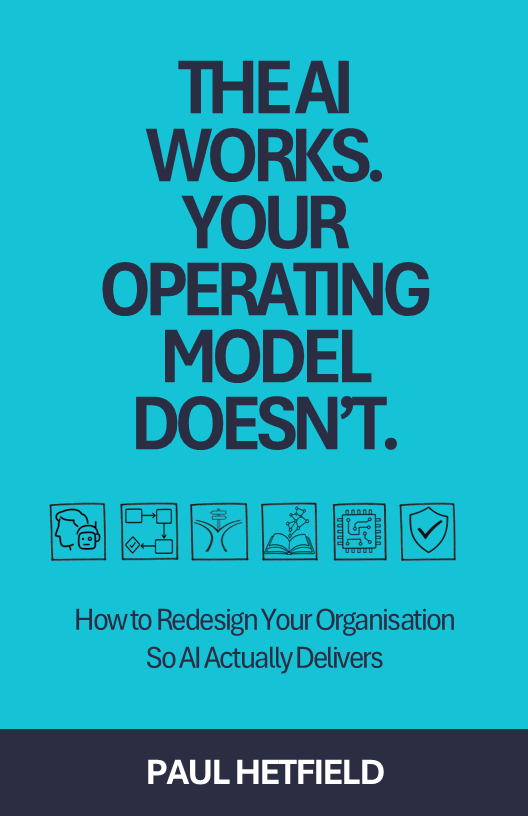
A practitioner book. Not a book about AI, but about what AI integration demands of operating model design. It sets out the Six-Layer Method in full, with the maturity model, diagnostic tools and case material.